Saturday, June 20, 2015
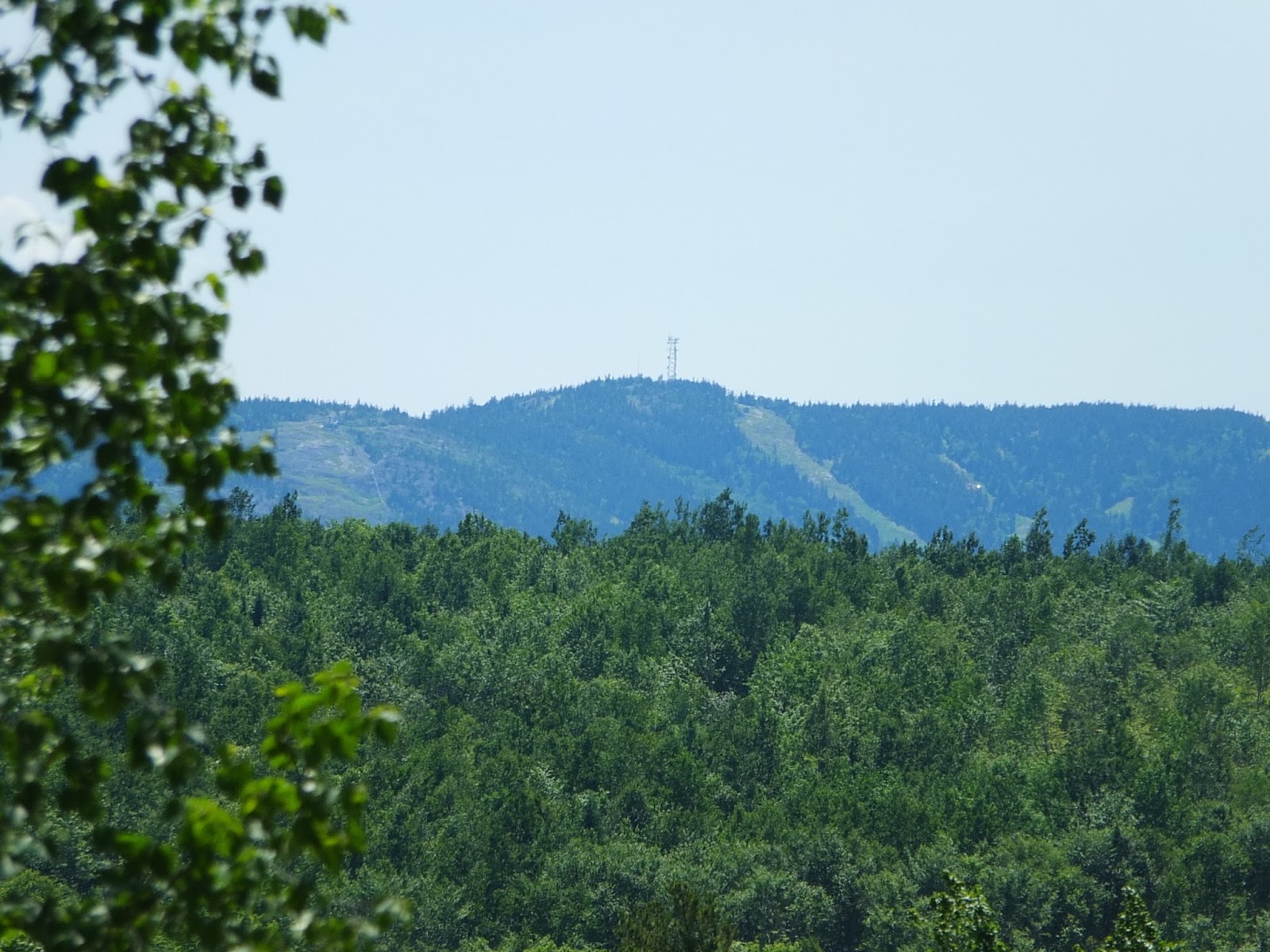
Climbing Around Howard Pond.
About 12 minutes outside of Rumford there's a little alpine pond wedged between several mountains in the town of Hanover. Howard Pond is a quiet community with dozens of cabins lining the shore. The first hike we took went up an old road through a logging area and up onto more established logging roads. We got glimpses of Sunday River Ski Resort, but no views of the lake. Here are some of those photos:
After that climb, we went up Woodman's Trail right at the top of the Howard Pond road where you first see the pond. It's a 15-minute hike with a good view.
Friday, May 22, 2015
Clancy, Bailey, and Sharon
Clancy and Bailey are "stuck" with Aunt Sharon this Friday. They've been walking and enjoying this sunny day in Maine. Although Clancy is under the weather, he seems to be doing just fine... searching for food, carrying a ball around, sniffing this and that... he's a good boy.
![]() |
| Is that you, Uncle Richie? |
Monday, April 13, 2015
Saturday, January 24, 2015
Out of Print

In 1991, after a summer at Middlebury College's Bread Loaf School of English, I began keeping notes in my high school English classroom. Some notes were written in hard-bound journals and others were kept on scraps of paper and dropped into a file folder.
I learned about being a teacher-researcher in the classroom of Dixie Goswami and James Britton. Over the course of the summer, they demonstrated how listening closely and writing their understanding helped them "come to know" more about their students, their classrooms, and their own learning. Not surprisingly, their graduate class was called "Coming to Know"; in our class, Dixie and Mr. Britton exemplified teachers as learners.
I didn't know it during the fall of 1991, but the notes I began keeping were the genesis of three books, Room 109: The Promise of a Portfolio Classroom, Beyond Room 109: Developing Independent Study Projects, and A Guide to Creating Student-Staffed Writing Centers, Grades 6-12.
This fall, I received a letter from my publisher informing me that Room 109 would be going out of print. The writer invited me to buy the remaining warehouse copies and she promised to send me the PDF of the book to do with as I wished. "109" sure had a good run. I use the book in one of my classes for future English teachers. They always wonder how I managed such a classroom with 115-120 students, especially after I share a collection of portfolios with them. I have great memories of those high school teaching days. They're strong memories because of my students… and because I wrote about them in my notes and then in these books. Here's the back cover copy:
![]() |
| Click on photo to enlarge |
Thursday, January 8, 2015
Writing truly is rewriting. (40/60)
Sunday, October 19, 2014
Writing, Hosting, and Living….
| Birthday Hike on Mt Zircon, October 12, 2014. Click on photo to enlarge. |
![]() |
| Lea Maurer |
I'm finishing another Writing on the Bus companion book. The Swim Team Notebook is coauthored with Lea Maurer of Stanford University. What a privilege to work with Lea. She's down-to-earth, self deprecating, playful, and smart. An Olympic gold and bronze medalist--and a 1998 World Champion--Lea coached Stanford's swim team from 2005 - 2012; now, she's taking time off to raise her two boys. Currently, she volunteers with the men's water polo team at Stanford helping with stroke technique and conditioning.
Writing these team notebooks demands a level of organization and discipline; working with a variety of coauthors has been challenging in good ways. These extraordinary coaches are out of their elements as writers, but they love the idea of the team notebooks. Beyond their coaching expertise, these top professionals bring organizational skills, unique ideas, and a level of discipline and organization that effective writers have. My job has been to make the book project doable for each and to lead them through the book in small, manageable steps. It's been a lot like teaching.
For me, the writer, the team notebook projects don't push my writing skills or satisfy the writer I hope to be. I enjoy the projects and my coauthors, but I don't feel stretched. Now, with two teenagers in the house for 8 more months replete with their laundry, dinners, school lunches, homework, love lives, sports, Blog, the time they need and deserve, the writer I am has to find balance. Does this mean I am right back to where I started without foreign teenagers?
This balance needs to include a writing project that inspires. And that's where I sit today… thinking through the possibilities.
Friday, September 5, 2014
The English Journal (39/60)
Saturday, August 30, 2014
Coming up for air….
![]() |
| Tubing on Lake Webb with my nephews at the controls. |
I received an email yesterday from the boys' organization, Youth for Understanding. They're still trying to place 49 kids. Wow… I can't imagine how those kids feel sitting at home without an American family.
As usual, I'm keeping a blog of the boys' experiences for their families and friends. Scroll through their website/blog to get a sense of what we've been up to the past few weeks.
Saturday, August 16, 2014
Growing the family, yet again… 38/60
![]() |
| Jose, Bar Harbor, 1985 |
Over the years I have welcomed many international students into my home. These kids have helped expand a part of my life in ways that teaching and coaching have. But welcoming teenagers into your home on a 24/7 basis goes well beyond a teachers' life. Ha! Talk about understatement.
![]() |
| Sofia, Felipe, Jose, and Noemi c. 2011 |
After a couple of years away from hosting, I've jumped back in… and happily so. Meet Rasmus and Felix from Denmark and Germany. Involved, smart, and athletic kids, these boys are taking a year away from family and friends to explore the American way of life, to better their English, and to have a good time. Bailey and I--and the Rumford community--will do our best to make this a terrific year in the USA for both young men.
![]() |
| Felix, Bailey Tuckerman, and Rasmus, August 15, 2014 |
Thursday, August 14, 2014
A life of contemplation
![]() |
| One with the carpet… click to enlarge. |
Perhaps he's sniffing his back paw and all the great smells he came upon this morning on our walk. Maybe there's leftover peanut butter from yesterday's Kong, stuffed with cookies and smeared with Jiff.
Or maybe he's thinking about the long gentle road up Red Hill or the pool on top of the Parker Ridge Trail where he rested after summiting on a hot August day. Maybe he remembers last night's belly rub or the long strokes of the brush down the middle of his back.
| Top of Parker Ridge with Tumbledown Mt and Crater Lake in the background. |
Thursday, August 7, 2014
Hiking up to think back: Whitecap with Darren Miller
![]() |
| "Treats galore!" Darren & Bailey on Whitecap's western summit. Click photo to enlarge. |
![]() |
| Darren: Whitecap's west summit Click to enlarge photo. |
I love reconnecting with former students so many years later. It's interesting to hear about their lives. I remember Darren as a bright-eyed teenager filled with positive energy–he always wore a smile. Darren had a slew of active friends and loved soccer, skiing, and tennis. It's fascinating to come to know the adult version of former student-colleagues. Their stories of days gone by spark many memories… what a great way to hike a mountain.
See you again, Darren!
![]() |
| Click to enlarge. |
![]() |
| The old guy and his hiking partner. |
![]() |
| Toward Concord Pond. |
![]() |
| Western View Toward Sunday River and the Presidential Range. |
![]() |
| Toward the Androscoggin River Valley |
Monday, August 4, 2014
Exploring the Black Mountain Glades
![]() |
| Aurele Legere Ski Jump, Black Mountain, c. 1981 Click on pictures to enlarge. |
As I stared at the pile of debris on my hike, I remembered sitting up on top of the jump during the summer of 1981. The wind blew and rocked the tower back and forth while I drafted my poem, "Summer Jump."
The rest of the hike through several glades and main trails sucked the wind out of us because the temperature and humidity were both fairly high. Nonetheless, a good hike with interesting memories.
![]() |
| Bailey in the glades |
![]() |
| Western Mountains of Maine |
![]() |
| Cooling mechanism in full swing! |
Sunday, August 3, 2014
Papers for Full Professor… 37/60
July has been focused on two classes, several writing projects, and paperwork to advance to full professor (plus as many afternoon hikes as I could arrange). I've called my bid for full professor the "last hoop" of my academic career.
If you're not familiar with academic rankings, most universities follow a similar hierarchy:
–Adjunct, a part-time instructor
–Clinical instructor, lecturer, research associate, or research professor (non-tenure track positions that are often fixed termed like 3 years in length)
–Assistant professor (tenure track, full time)
–Associate professor (with tenure)
–Full professor
I've held all of these posts, except "full," starting as an adjunct lecturer with at University of Maine at Farmington in 1986. I taught 3-4 courses per semester in the English department for 3 1/2 years. These jobs pay around $2000 per course with no benefits. Universities now hire many adjunct instructors to keep costs low.
Generally, it takes 6 years of work to move from assistant professor to associate. Beyond being hired for a tenure-track position, reaching associate professor with tenure is the big prize. If you're not familiar with tenure, check out this explanation online. Advancement to associate happens once you've conducted research studies and published, received reasonable teaching evaluations, and provided service to your department, college, university, and beyond.
During each of those 6 years, a professor puts together an overview of work accomplished and that collection is reviewed and written about by the peer committee, associate dean, and dean of the college. Next, the dean makes a recommendation to the provost (vice president of the university and chief academic officer) for rehiring (or not) and the provost makes a recommendation to the president. Each year, an assistant professor receives a letter from the university president saying "upon the recommendation of the Provost…"
To advance from assistant professor to associate professor with tenure, the hoop gets bigger –or– perhaps I should say tighter! If you're doing poorly at year 4, the powers-that-be tell you and either give you a year to find a new job or provide you a mentor if they think you're worth salvaging. (No pressure, professor. No pressure.)
To move on to full professor, a person needs to be a recognized expert in the field. At Research I universities like the University of Maine, UCLA, or University of Vermont, a professor must be well published and have a well-rounded CV. The first step in moving to "full" is to find three outside experts in your field to review and write about your academic materials. These external reviewers must be full professors or well qualified university administrators. I've spent a month organizing my cover letter, CV, and publications for the external reviewers. I also had to buy some of my own books to ship off to them. Education books are expensive even with a 40% author's discount.
Th next step... the associate professor follows a standard protocol and presents papers to the college/department peer committee. Those papers go up the line to the president, and if she approves, the papers go to the Board of Trustees. (No pressure, professor.)
For me, this process is happening June 2014 through March 2015. Tuesday, my materials go to my external reviewers. In October, my papers go to the peer committee and start their journey through the university hierarchy.
I remember my first day at UMaine, September 2003. I was walking across campus and happened to see our college's associate dean, Anne Pooler. She had been a career academic after a stint as a high school social studies teacher. With her always present smile, Anne called out across the quad, "Good morning, professor!" The pressure was on.
If you're not familiar with academic rankings, most universities follow a similar hierarchy:
–Adjunct, a part-time instructor
–Clinical instructor, lecturer, research associate, or research professor (non-tenure track positions that are often fixed termed like 3 years in length)
–Assistant professor (tenure track, full time)
–Associate professor (with tenure)
–Full professor
I've held all of these posts, except "full," starting as an adjunct lecturer with at University of Maine at Farmington in 1986. I taught 3-4 courses per semester in the English department for 3 1/2 years. These jobs pay around $2000 per course with no benefits. Universities now hire many adjunct instructors to keep costs low.
Generally, it takes 6 years of work to move from assistant professor to associate. Beyond being hired for a tenure-track position, reaching associate professor with tenure is the big prize. If you're not familiar with tenure, check out this explanation online. Advancement to associate happens once you've conducted research studies and published, received reasonable teaching evaluations, and provided service to your department, college, university, and beyond.
During each of those 6 years, a professor puts together an overview of work accomplished and that collection is reviewed and written about by the peer committee, associate dean, and dean of the college. Next, the dean makes a recommendation to the provost (vice president of the university and chief academic officer) for rehiring (or not) and the provost makes a recommendation to the president. Each year, an assistant professor receives a letter from the university president saying "upon the recommendation of the Provost…"
To advance from assistant professor to associate professor with tenure, the hoop gets bigger –or– perhaps I should say tighter! If you're doing poorly at year 4, the powers-that-be tell you and either give you a year to find a new job or provide you a mentor if they think you're worth salvaging. (No pressure, professor. No pressure.)
![]() |
| Selected books to be sent to my 3 external reviewers with about 9 articles, a cover letter, and my CV |
Th next step... the associate professor follows a standard protocol and presents papers to the college/department peer committee. Those papers go up the line to the president, and if she approves, the papers go to the Board of Trustees. (No pressure, professor.)
For me, this process is happening June 2014 through March 2015. Tuesday, my materials go to my external reviewers. In October, my papers go to the peer committee and start their journey through the university hierarchy.
I remember my first day at UMaine, September 2003. I was walking across campus and happened to see our college's associate dean, Anne Pooler. She had been a career academic after a stint as a high school social studies teacher. With her always present smile, Anne called out across the quad, "Good morning, professor!" The pressure was on.
Subscribe to:
Posts (Atom)


%2BKent_Page_1.jpg)
%2BKent_Page_2.jpg)
%2BKent_Page_3.jpg)
%2BKent_Page_4.jpg)
%2BKent_Page_5.jpg)
%2BKent_Page_6.jpg)
%2BKent_Page_7.jpg)